
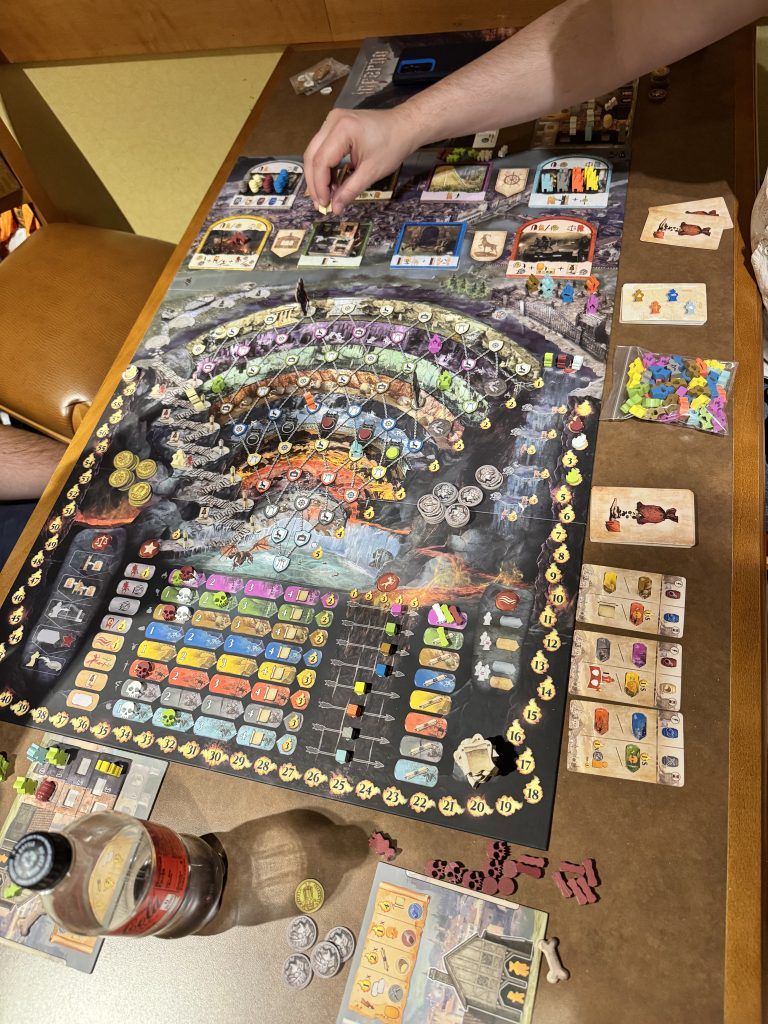
Introduction: Taking Steps Down Hell
Games involving the afterlife have an odd history. Few games send players off into the void, however. We’ve run meeples through Elysium, turned cubes into Cathedrals, placed faith tokens in towering structures that seek to touch Heaven, etc. However, few games encourage the player to take a leap of faith and drop down the pit. Inferno (designed by Fernando Eduardo Sanchez), published by Red Mojo Games and Grand Gamers Guild, does nothing to placate those fears. Here, Florence is above, Hell is below, and we are stuck in between, trying to shove sinners from hay stacks and palaces into whatever eternal suffering they so rightly deserve.
The idea itself is enough to differentiate it. However, instead of simply slapping some thematic paint on the game, Inferno transforms the Divine Comedy (yes, that Divine Comedy) into a game of moving, accusing, bribing, and sometimes backstabbing. As I’m sure you agree, this sounds like a recipe for satire. To my surprise, and probably to yours also, Inferno actually succeeds.
This is not to say it’s perfect. Some areas shine, while others are a struggle to breathe. Some elements feel essential, while others seem vestigial. Some nights in Hell burn with an inferno of flames, while others will sputter. However, similar to Dante’s journey down the pit of hell, Inferno is memorable due to its inconsistent nature. While the trip may be just as fun as arriving at the bottom of the mountain, there are certainly sections of river that will make you wish you were already home.
Let’s pull back the curtain and explore the underbelly of Dis. Let’s debate whether certain artistic representations are accurate depictions. Let’s enjoy watching our opponents’ guardians, and maybe even yell at Phlegethon for clogging up our maps again.
How Does Inferno Play?
An evening playing Inferno is divided into two stages: the Hell phase, and the Florence phase. Both pieces fit together to create a rhythm that moves players between these two worlds.
In the Hell phase, your objective is to move a soul downward, ideally into its corresponding circle of the underworld. Maybe that’s a lustful soul who’s floating away on eternal winds, or a greedy merchant forced to push his heavy stone up the hill for eternity. Each soul has a color that corresponds with a circle of Hell. You want to place that soul in its corresponding circle of Hell, as you’ll earn the Infamy points shown for that level. However, other players are doing the same thing. Players can block each other’s paths, shift souls, and put obstacles in front of each other. The map of Hell will become a shared puzzle of both opportunities and roadblocks.
Once you finish the Hell phase, you move on to the Florence phase. Now you’re placing your family members, noble men dressed in fine clothing and orphans found in the hay stack, into eight separate locations in the city. Each location provides unique abilities: steal barrels from the market square, recruit important people to come visit you at the palace, launder money at the bank, or point fingers at sinners and toss them into the graveyard.
Both phases interconnect in a creative manner. Wherever you finish your Hell phase will determine where you need to act during the Florence phase. Of course, if you’d rather give Charon two Drachmas to ignore your previous actions… bribery is always good business.
The beauty of Inferno lies in linking both sides of your turns: the descent of souls is more than just bookkeeping. It informs where you’ll be able to act civically. And your civic meddling will help fill Hell with more souls to escort. Each part of your turn brings meaning to the other. This creates a beautiful waltz between damnation and politics.
As time passes, your family will dwindle. Family members sent to accuse sinners end up trapped in your tower. Since they’re gone, your options decrease dramatically when attempting to act. You can add new floors to increase your tower’s size, take in additional urchins to provide more “manpower”, or clear space within your tower. Still, eventually, you’ll find yourself feeling cramped.
Eventually, Dante (the neutral observer) will advance one step at a time towards completing the game.
Together you’ll descend into Hell… not necessarily as a unit, but in an interconnected manner via various plans/strategies/plots/betrayals.
The Guardians: From Gimmick to Icon
When I initially opened the box for Inferno, I believed that the guardians were mere gimmicks. Certainly they would be something you’d use once or twice throughout a game and then store them away with the rest of the rulebook as a novelty item akin to “Angry Farmers” in some medieval-style Euro game. However…
During our initial plays of Inferno only two of them demonstrated their ferocity (Medusa & Cerberus). Those two alone proved their value.
Medusa essentially freezes souls into grotesque statues; in practice this means locking entire routes closed. A soul she froze became an immoveable landmark; a testament to both her mythical strength and the designers willingness to allow Hell’s landscape to become congested in unpredictable manners. She wouldn’t activate every turn, sometimes she would remain dormant, but when she did it caused ripples. What previously seemed like an elegant plan now was tangled and chaotic; players scrambled to discover new routes past her victims.
On the other hand Cerberus represented pure chaos. He allowed you to save up his bones and then exchange them for frightening souls down further into the Circles … Essentially he provided a hidden slingshot. Just when someone thought they had sufficient time to position themselves for maximum impact Cerberus would bark and suddenly their soul would be knocked lower down into the Circles, possibly over the Wall of Dis if the necessary safe passage was available, or against a shield that had previously been inaccessible, but never beyond its matching circle. During our game his activations generated real laughter – half amusement/half frustration.
What really stood out was how differently each guardian played. Medusa was slow-moving, inevitable, suffocating. Cerberus was rapid-paced, erratic, exciting. Together they provided Inferno with its distinct personality. Without either of them descending down Hell would likely be very organized. With both of them it was chaotic, messy, memorable.
The remaining four guardians (Antaeus with his chains: Geryon with his pits, Minos with his tail, and the Minotaur with his labyrinth) are still untouched for me. However merely perusing their rules I am confident I can visualize new combinations. This is the joy of having modular guardians, they alter the puzzle for each playthrough.
Guardians are relevant because they demonstrate Hell’s capriciousness. Without them Inferno may be reduced to predictable gameplay patterns: a puzzle-based optimization problem of finding the shortest route. With them Inferno remains dynamic, unpredictable, living. They do not overshadow the core mechanics of Inferno; they keep the fire burning.
In fact I believe that Inferno’s guardians represent its greatest attribute. Their versatility, their ability to disrupt strategy/tactics/thematic relevance (all enhance the experience).
Infernal Rivalry: F***ing Over Other Players
If you squint closely Inferno appears slightly like a train game. Not literally, although there are no trains traveling through Florence (unless you consider Charon’s ferry as a sort of grim commuter rail), but metaphorically.
Train games typically generate excitement from blocking other players from using specific connections or tracks. You snag a connection before another player can utilize it; or lay track forcing a rival player to detour. Inferno achieves similar feelings as well. You can secure a path in Hell that another player clearly needs; you can force another player to spend extra resources by manipulating a soul downward; you can acquire a visitor in Florence that prevents them from accusing in a critical area.
Delicious indeed. And it rarely crosses into cruel territory. Unlike many punishing train games, where one poor draw can lead to complete irrelevance, Inferno retains a playful edge to blocking. Blocking may hurt, but it won’t destroy someone’s career. There will always be alternative routes; there will always be another sinner to accuse.
Finding that balance is difficult for many games. Too many Euros attempt to remove multi-player interactions altogether and reduce it to multi-player solitaire; sanding down social interaction until players appear to be playing individually. On the other hand too many games turn every decision into a zero-sum battle of attrition. Inferno strikes a happy medium between both extremes. You’ll laugh when someone blocks you; you’ll undoubtedly swear, but with a smile.
Interconnected Action Chains: Interaction Without Burning
Perhaps the strongest aspect of Inferno’s action mechanism is how enjoyable it is without being overwhelming.
Each turn you are juggling multiple decisions: should I send my family member somewhere? Should I construct my tower? Can I accuse this sinner? Am I going to move those barrels? Should I play my fraud card? Each decision affects subsequent decisions and/or has multiple ripples – but never enough that you feel overwhelmed or unable to decide what action to perform.
Unlike many heavy Euros that present players with dire consequences resulting from poor decision making (or lack thereof), Inferno’s consequences are easily managed.
Even better is that many of your actions will connect to one-another. For example: accuse a sinner and advance on your sin track; advance up your sin track and possibly earn a half-diploma toward a future end-game bonus; meanwhile your family member is moved into your tower limiting your options available in your next turn unless you clean out space in your tower.
You can tell when designers intentionally create systems where players feel intelligent without fearing for their lives due to overwhelming information flows. Each turn has meaningful intent, even if not idealized.
That’s rare and highly valued.
When Icons Fail: A Very Bad Experience With Iconography
Iconography can either enhance your gaming experience or get in the way. For myself, it failed. I found myself focusing on the symbols and trying to figure out what the zig-zag line indicated (“move a sin track” or “pay drachmas to move a guardian”). While some icons are straightforward, others seem as enigmatic as hieroglyphics. This might simply be a case of “my problem”. My mind works poorly, and after learning the symbols, the icons became second nature. The rules book provides excellent guidance. However, the initial impression is everything. Initially, I was confused.
An elegant game such as Inferno is ruined by confusing iconography. Iconography should serve to aid the player in making decisions rather than create roadblocks. Unfortunately, this is sometimes the result of using iconography in Inferno.
Thematic Annihilation: Why the Theme of Inferno Matters
I generally do not care about themes in games. Most games view themes as an accessory. Inferno is different.
The theme of Inferno is incredibly intense. Furthermore, it is well-integrated into all of the mechanisms in the game. As your family accuses sinners in Florence, those accused populate the grave yard with souls.
Progressively moving down through the levels increases your Infamy. The guardians in the game are not random creatures – they were drawn directly from Dante’s work. Even the currencies used in the game – Florins and Drachmas – add another layer of depth to the game by highlighting two economies; the economy of civic life and the economy of bribing infernal forces.
This creates a level of authenticity in Inferno that few games achieve. Not historical accuracy (the rulebook itself states that there were creative liberties taken) but an emotional connection to the theme. Inferno allows players to inhabit a world of sin and punishment during gameplay. Unlike many Euros, this game would lose its identity if you removed its theme.
That makes it memorable.
The Problem with Phlegethon
Every fire burns hot for a little while before it dies off to embers. Inferno has its own share of warm puddles. For me, it is the Phlegethon Track. In theory, this River of Blood should be an active scoring element throughout the entire game. During the end-game, each circle’s Phlegethon Track Cube is reduced based on how many empty shields remain in that specific circle. The higher number of filled shields results in bigger scores. Conversely, leaving shields unfilled reduces the score multiplier significantly.
In practice…meh.
During our plays of Inferno, we never really noticed the impact of manipulating the Phlegethon Track. There were often enough empty shields that the adjustments rarely made a difference. Managing it felt like unnecessary busy-work. Scoring was relatively consistent across most games. This suggests that there may have been some underlying influence, however it was not impactful enough to make a difference in terms of decision-making. Feeling matters when playing games.
Perhaps additional plays will show hidden strengths in the Phlegethon Track. Perhaps among groups who obsess over optimizing mechanics, Phlegethon will become a razor-sharp point of contention. For casual and medium-core groups however, it has potential to become Inferno’s weakest link.
The End Game: A Satisfying Conclusion
End-games can either peak or dwindle. Inferno successfully peaks.
As Dante journeys towards his final destination, tension builds. Players frantically search for diplomas, pursue fraud card conditions and attempt to extract as many points as possible from their towers. After the remaining players each take one last turn, players enter a scoring phase: fraud cards reward players if they meet their requirements, the Phlegethon Track adjusts. Diplomas multiply against Sin Tracks. It is a very satisfying mathematical process, although the drag created by the Phlegethon Track dampens it somewhat.
The conclusion of Inferno aligns perfectly with the theme: inevitability is reached and frozen at the base of Hell. No one escapes. Everyone’s actions are accounted for. Your family is evaluated based upon your infamy (not virtue). It is perfect.
A Broader View: Where Does Inferno Fit Within Board Games?
How does Inferno fit within the large number of board games available?
It cannot be classified strictly as a Euro-game (although it has elements of Euro-style design). It is not a train game (though it appears to be). It is neither AmeriTrash nor Euro-trash (although it certainly has a significant amount of thematic weight). Rather, it falls somewhere in-between. Inferno is an example of a Hybrid-Thematic Euro game with bite.
Thusly, it sits amongst other examples such as Blood Rage (in terms of both theme/mechanism fusion), Brass (in terms of aggressive blocking), and Viticulture (in terms of multi-stage rhythmic pacing). However, Inferno also exists independently – and boldly attempts to transform Dante’s Divine Comedy into meeples.
Will it be perfect? No. Is perfection needed? No. Simply because Inferno dares to take Dante and convert him into meeples; and has done so with style, makes it worthy.
Conclusion: Flaming Ambitions Are Always Worthy
Inferno took me aback. Both Cerberus and Medusa are not simple gimmicks; they are beautiful standees with meaningful mechanisms. Even with only these two present, the action system hummed along; the theme burned brightly; and the player interaction sparked.
However, I was also letdown by Inferno. The iconography frustrated me; and the Phlegethon Track lacked punch.
However, overall? It’s a great place to visit hell.
Not every game requires perfection. Many simply require being remembered. And Inferno is unforgettable.
Final Verdict: 8/10
No products found.

Paul Shapiro is Founder and Editor of Board Game Squad. He enjoys all types of games and experiences, but has a particular penchant for medium to heavy eurogames.